


Knife Safety Starts with Control
A sharp kitchen knife can be intimidating. But knife safety isn’t simply about being careful. It’s about control.
How you hold your knife, how you guide the food, and how well you maintain the blade all affect how safely and confidently you can work.
Good knife skills take practice.
How You Hold a Knife Matters
Many people instinctively hold a chef’s knife entirely by the handle, with their hand positioned behind the bolster—the point where the blade meets the handle.

Hold a knife this way and gently move it from side to side. The blade can move left or right with surprisingly little effort. That lack of control is something I don’t like.
Now choke up on the knife.

With what is commonly called a pinch grip, your thumb and index finger grip the blade just in front of the handle or bolster, while your remaining fingers wrap comfortably around the handle.
Your hand is now closer to the knife’s center of balance. Small movements become more deliberate and you have more direct control over where the blade goes.
For me, choking up on the knife makes every movement much more purposeful.
If you’ve always held your chef’s knife completely behind the bolster, try a pinch grip. Start slowly and pay attention to the difference in balance and control.
Protect Your Fingers with a Claw Grip
Your knife hand controls the blade. Your other hand needs to keep your fingers out of its path.
Curl the fingertips of the hand holding the food inward to form a claw grip. Keep your fingertips tucked behind your knuckles and use the side of the knife against your knuckles as a guide.

The claw grip does two things: it keeps your fingertips away from the cutting edge and helps you control the food.
Also make sure the food itself is stable before cutting. Round vegetables such as onions and potatoes can roll under a knife. Whenever possible, create a flat surface first and place that side against the cutting board.
Slow Down Before You Speed Up
Watch an experienced cook and knife work can look effortless. That speed comes from repetition.
Speed should never be the goal when learning knife skills. Control should be.
Practice slowly. Learn how the knife feels in your hand. Practice the pinch grip and claw grip, and concentrate on making deliberate, consistent cuts.
As those movements become familiar, speed develops naturally.
Good knife skills are muscle memory, and muscle memory takes practice.
A Sharp Knife Is a Safer Knife
It may sound counterintuitive, but a sharp knife is safer because it is more predictable.
When a sharp knife meets the firm or smooth skin of a vegetable, the edge should pierce the surface and begin cutting with very little pressure.

A dull knife is more likely to slide across the surface instead of piercing it. That is where a knife can become dangerous. You instinctively compensate by applying more pressure. If the blade suddenly slips, that additional force can send the knife somewhere you didn't intend—including toward your fingers or hand.
A sharp knife requires less force and gives you greater control.
If your knife is sliding instead of piercing, stop and check the edge.
When You Know It’s Time to Hone or Sharpen Your Knife
One of the easiest ways to tell if your knife needs attention is to pay attention to how it first contacts food.
For me, a bell pepper is one of the easiest tests. But you can also notice it when cutting vegetables with firmer or resistant outer skins, such as an onion, eggplant or winter squash.
A properly maintained knife should bite into or pierce the surface without significant pressure.
If the knife slides across the surface before it begins cutting, it’s time to hone or sharpen your knife.
Other signs include:
You need noticeably more pressure to make a cut.
You find yourself sawing back and forth through foods that should cut easily.
The knife crushes or tears food instead of cutting it cleanly.
The blade doesn't immediately bite into the food.
The knife feels less predictable when it first contacts the food.
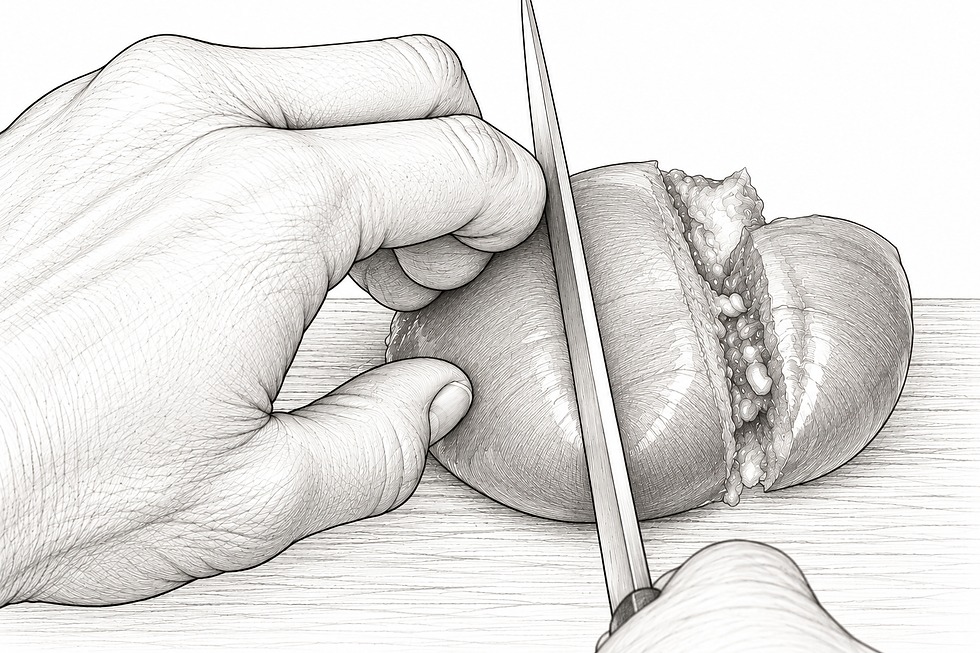
Don't compensate for a dull knife by pushing harder. Stop and address the edge.
Hone First. Sharpen When Needed.
Honing and sharpening aren't the same thing.
Honing maintains the edge. With use, the very fine edge of a knife can become slightly misaligned. An appropriate honing rod can help realign that edge without significantly removing metal.
Sharpening restores the edge. Sharpening removes a small amount of metal to recreate a keen cutting edge when honing alone can no longer restore performance.
A simple approach is:
Knife slides instead of piercing → Hone it → Test it again → Still sliding? It's time to sharpen.
You don't need to sharpen a good knife constantly. Sharpen it when honing no longer restores the cutting performance you expect.
A Few Habits Make a Big Difference
Keep your cutting board stable. If it moves on the counter, place a damp towel or nonslip mat underneath it.
Never leave a knife hidden in a sink or underneath other dishes.
Use wood or appropriate synthetic cutting boards rather than glass, stone or other very hard surfaces that can quickly damage an edge.
Wash good knives by hand and dry them promptly. And don't rush.
A great knife should feel like an extension of your hand. Developing that relationship takes time.
The objective isn't to cut faster.
It's to know exactly where your knife is going before it gets there.
Learn. Taste. Discover.


Comments